Florida House: Redistricting Boosts GOP prospects

Florida’s new congressional map could net House Republicans as many as four additional seats this fall, though it could also result in much smaller gains for the GOP.
The plan, approved by the Florida state legislature and signed into law by Republican Gov. Ron DeSantis, comes in the wake of Democrats’ aggressive redraw in Virginia, in the latest battles of the redistricting war.
The new map eliminates one Democrat-held district south of Orlando. Tampa’s Democrats, once mostly concentrated in the 14th District, are now cracked across four districts that each voted for Trump by 10 to 20 points. And although Democrats carried five South Florida seats in 2024, that delegation might be reduced to three after 2026.
Kamala Harris would have finished ahead of Donald Trump in four seats under the new map, compared to eight under the previous map.
DeSantis argued that the previous map was drawn, by Republicans, using flawed census data on unconstitutional grounds. His team contended that Florida’s Fair Districts Amendment, which was approved by voters in 2010 and bars gerrymandering for partisan purposes, would run afoul of the anticipated — and ultimately delivered — Callais decision from the Supreme Court.
The old map contained four majority-Hispanic districts while the new map only contains three: one of the eliminated Democratic-held seats, Florida’s 9th District, is now 41 percent Hispanic.
The map is already facing legal challenges, but most of the justices on the Florida Supreme Court are DeSantis appointees and the court previously approved the 2022 map, which itself advantaged Republicans.
North Florida
There are no changes to Florida’s 1st, 2nd, 3rd, 4th, 5th and 6th districts in North Florida. There also weren’t any changes to the 7th District, currently represented by GOP Rep. Cory Mills, But the congressman is the subject of an ethics investigation and the race is competitive and rated Likely Republican.
Central Florida
The 8th District pulls more into Orange County toward Orlando, picking up University of Central Florida from the 10th District, in exchange for Indian River County. The district’s Baseline average would tighten from R+23 to R+17 — but cozy enough for Republican Rep. Mike Haridopolos to likely win re-election.
Florida’s 9th, represented by Democratic Rep. Darren Soto, is dramatically redrawn. Once contained around Kissimmee, the district is now sprawling — approximately three-fifths of the population in the old 9th District overlaps with the new version. The new lines include Indian River County (home to Vero Beach and Sebastian) and extends south into Highlands (Avon Park and Sebring), Glades, and Okeechobee counties.
In return, the district drops some of its reach into Orlando and Kissimmee — and Poinciana entirely. The Hispanic population decreases from 54 percent under the old lines to 41 percent under the new map, meaning it is no longer majority Hispanic. These changes would be enough to flip the 9th District’s Baseline from D+10 to R+15. And it’s trending toward Trump: he won by 2 points in 2016, 7 points in 2020, and 18 points in 2024.
But Soto appears willing to seek re-election to his reconfigured seat. According to Jacob Ogles of Florida Politics, possible Republican candidates in the 9th District could include Osceola County Commissioner Ricky Booth and former state Rep. Mike de la Rosa. Likely Republican.
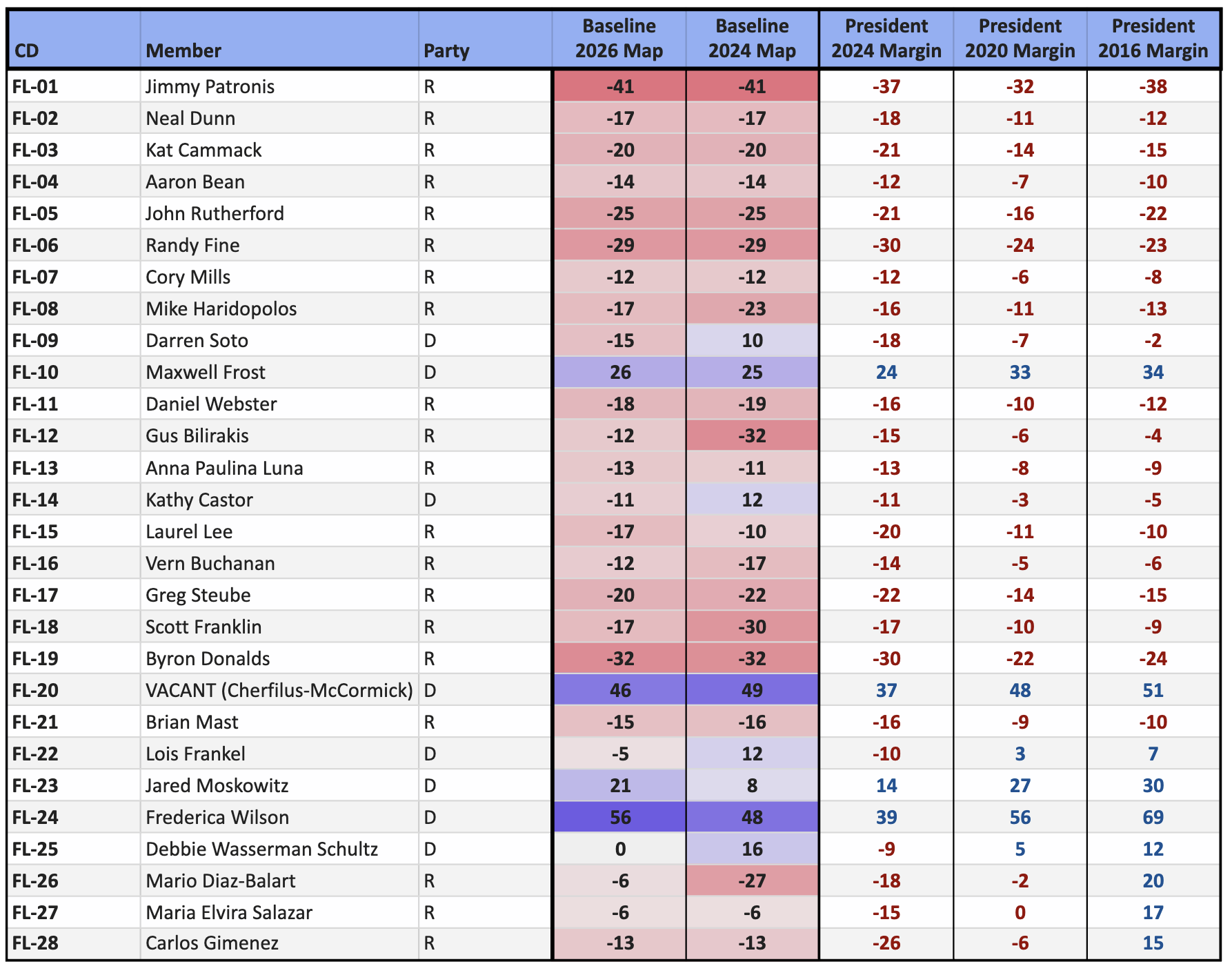
Florida’s 10th District. The demographics are virtually unchanged — retains three-fourths of its current population. The district is still located completely within Orange County but exchanges UCF for reach into South Apopka. The new map increases Democrats’ Baseline advantage in the 10th District by one point to D+26. Democratic Rep. Maxwell Frost is in no real danger. Solid Democratic.
Florida’s 11th District retains 85 percent of the population. Already containing Walt Disney World, it now reaches past Doctor Phillips to take in Universal Orlando Resort. Baseline moves from R+20 under the old lines to R+18 under the new lines. After Republican Rep. Daniel Webster announced his retirement, six Republicans and four Democrats have filed to run, including Lake County Commissioner Anthony Sabatini, who briefly ran against Webster in the 2024 primary. Solid Republican.
Tampa Bay
Florida’s 12th District shifts south as the district and is still reliably red, but becomes much bluer — from R+34 to R+12. The new lines drop Citrus and Hernando counties and now reach toward Dade City with substantial reach into Hillsborough County toward Tampa. The district retains 41 percent of the current 12th District’s population, with the rest split between the old 14th and old 15th. The share of adults with a Bachelor’s degree jumps from 24 percent to 34 percent, close to the national average of 37 percent. The share of white population drops from 74 percent to 55 percent, while the Hispanic share rises from 15 percent to 28 percent.
While Trump would have carried the new 12th by 15 points, he would have secured a narrower 6-point victory in 2020. Republican Rep. Gus Bilirakis has said he will seek re-election to the 12th District. Democrat Kim Overman, the former Hillsborough County commissioner who had been running in the 15th District, said she will instead run against Bilirakis. Army veteran and former CIA officer Chris Irizarry is also running. Solid Republican, but worth keeping an eye on in a great Democratic year.
Florida’s 13th retains four-fifths of its population, anchored around Clearwater and the rest of central Pinellas County. The lines pick up northern portions of St. Petersburg in exchange for southern portions reaching toward St. Pete Beach. In the north, it also reaches into Pasco County. Retired Army Brigadier General Leela Grey is a compelling challenger to Republican Rep. Anna Paulina Luna, if she can make it through a crowded Democratic primary field. Likely Republican.
Florida’s 14th District is one of the Democratic-held districts targeted in the redraw. Currently held by Democratic Rep. Kathy Castor, the new 14th keeps less than one third of its old population, with around half of the new district’s residents coming from the old 16th District, and the rest from the former 15th. The 14th District previously included Tampa and St. Petersburg, but now only it takes a sliver of Tampa and none of St. Petersburg. The lines also extend away from the coast to take in mostly Republican precincts — plus some more evenly-divided areas near Brandon and Riverview, as well as majority-Hispanic Town ‘n’ Country.
In both versions of the 14th District, Hispanics made up 28 percent of the population. The average margin according to Baseline was D+12 on the old map and R+11 on the new map; Trump also would have carried the new version of the 14th by 11 points in 2024. The new 14th District looked better for Democrats last decade: it would have backed Republican candidates by 5 points on average in 2018 statewide and federal races, and Trump would have won it by just 3 points in 2020. Castor has said she will continue campaigning in this seat even with the less favorable lines. Lean Republican.
Florida’s 15th District used to be split between Polk, Pasco, and Hillsborough. But it now no longer reaches into Polk, and goes up into Hernando and Citrus. The new 15th shares only 36 percent of its population with the old version, with half of it coming from the old 12th District. But in return it becomes more solidly Republican, moving from R+10 to R+17 in Baseline. The seat used to connect Lakeland to Tampa, bringing in a range of communities including Pebble Creek, Plant City, and Zephyrhills — not to mention the University of South Florida. The new version drops Plant City, instead reaching toward Dade City in Pasco County and Brooksville and Spring HIll in Hernando County. GOP Rep. Laurel Lee would technically live in the new 14th District but has said she will run again in her current 15th — although she faces a primary challenge from Hernando County Commissioner Steve Champion. Solid Republican.
Florida’s 16th District contains around half of its old population, with another 20 percent coming from the old 13th District. The demographics don’t change much. Formerly confined to Hillsborough and Manatee counties, it drops HIllsborough in exchange for all of DeSoto County (Arcadia) and Hardee County (Wauchula), plus portions of Polk and Sarasota counties. The district no longer includes Riverview or Apollo Beach, and its baseline moves from R+17 to R+12. Republican Rep. Vern Buchanan is retiring, and Sydney Gruters, the wife of RNC chairman Joe Gruters, is the favorite to succeed him. Former Sarasota Mayor Kelly Kirschner, who comes from a prominent political family, is a credible candidate for Democrats and this district could be one to watch if the bottom falls out for Republicans. Solid Republican.
Florida’s 17th District retains 85 percent of its population, keeping all of Charlotte County. It sheds a slice of Sarasota County, while in Lee County it trades most of Lehigh Acres in exchange for Fort Myers. There’s not much difference demographically and the partisanship moves slightly, from R+22 to R+20. Republican Rep. Greg Steube should be fine. Solid Republican.
Florida’s 18th District is much smaller area-wise — dropping a half-dozen less-populous counties — but the new lines retain nearly two-thirds of the original population, still situated in Polk County. Now geographically centered around Winter Haven, the district keeps Haines City and Lake Wales while picking up Poinciana and the rest of Lakeland. Demographics between both district versions are mostly the same, but the Baseline margin tightens from R+30 to R+17 — which is probably not a problem for GOP Rep. Scott Franklin. Solid Republican.
Florida’s 19th District retains 80 percent of its population. It still combines Cape Coral and Fort Myers with Naples. But the new version trades Fort Myers to the 17th District for Lehigh Acres, and drops Marco Island in exchange for residential communities east of Naples. Baseline partisanship stays at R+32 in this open seat, with GOP Rep. Byron Donalds running for governor. According to Florida Politics, “most of the Republicans running say they will stay” in the 19th District, but former New York Rep. Chris Collins, one of several former members making a comeback bid in the GOP primary, might also switch to running in the 19th District. Solid Republican.
Florida’s 20th District retains two-thirds of its old population. But it is much tinier geographically, trading in distant cities in Palm Beach County for closer precincts in Coral Springs and Fort Lauderdale — dropping the share of Black residents from 49 percent to 42 percent. The average Democratic advantage shrinks from 49 points to 46 points under the new map, making it safe for whichever Democrat replaces former Rep. Sheila Cherfilus-McCormick, who resigned following an ethics inquiry into a misuse of government funds reported upon first by Inside Elections. Cherfilus-McCormick is running for her old seat but faces a number of primary opponents, and there are rumblings that Rep. Debbie Wasserman-Schultz may also run here. Solid Democratic.
Florida’s 21st District keeps 95 percent of its old population, trading communities from its southern tip in Palm Beach County to make way for the new 20th District. The 21st District’s Baseline partisanship is one point less Republican-leaning than before — it is now R+15, which creates some wiggle room for GOP Rep. Brian Mast. Solid Republican.
South Florida
The previous map produced five Democratic-leaning seats in South Florida. But the new map packs Democrats into three districts: in West Palm Beach, Fort Lauderdale, and Miami.
Florida’s 22nd District. Both demolished Democratic-held seats are virtually unrecognizable after the makeover. The primary overlap between both versions of the 22nd District is Wellington in Palm Beach County — approximately 13 percent of the district’s population. (Meanwhile, 24 percent comes from the old 25th District, 22 percent from the old 23rd, 17 percent from the old 26h, and 12 percent from the old 20th, with the remainder spread across three additional districts.)
The previous version of the 22nd hugged the coast from Palm Beach to Delray Beach. But now Wellington, a half-hour drive from the beach, is the easternmost point — with the lines stretching down into the top half of Broward County and west to cover all of Hendry County and non-Naples Collier County. These changes transform the district from D+12 to R+5, and while Trump would have won the seat by 10 points in 2024, he would have lost it by 3 points in 2020. Demographically the district didn’t change much: 44 percent of the population is white and 34 percent is Hispanic, while 42 percent of adults have a college degree. Wasserman-Schultz might run here given the overlap with her old district. Tilt Republican.
Florida’s 23rd District is effectively a renumbered version of the 22nd District currently held by Democratic Rep. Lois Frankel. The new 23rd contains 80 percent of the old 22nd, with the remainder coming from the old 20th. The 23rd District previously resembled the number 7, connecting to Fort Lauderdale via Coral Springs and Parkland. But now the district moves north, bridging Delray Beach to Riviera Beach, with Boynton Beach, Palm Springs, and West Palm Beach in between. This packs Democrats, bumping the Baseline average from D+8 to D+21. The population is 39 percent white, 30 percent Hispanic, and 25 percent Black, and one-third of adults have a college degree. Florida Politics reports that Democratic Rep. Jared Moskowitz, who currently represents the 23rd District, “has his eyes” on running here over to the new 25th. But Frankel needs a home too. Solid Democratic.
Florida’s 24th District retains 70 percent of its old population, shedding its eastern reach into Miami Beach and North Miami Beach in return for northern reach into Hollywood. But both versions remain anchored in Miami Gardens and North Miami. The district is 43 percent Hispanic, 43 percent Black, and 10 percent white; 24 percent of adults have a bachelor’s degree, compared to 32 percent under the previous map). The Democratic Baseline advantage grew from D+48 to D+56 — a safe bet for Democratic Rep. Frederica Wilson to win her ninth term. Solid Democratic.
Florida’s 25th is another district with no true predecessor — formed by leftover pieces not used to pack the three remaining Democratic-leaning districts. Forty-six percent of its population comes from the old 23rd District, while 30 percent is from the outgoing 24th District and just 16 percent comes from the original 25th District.
The 25th previously stretched from Hollywood and Davie to Weston, Pembroke Pines, and Miramar. But now it only keeps the communities on the coast — one section of a long, thin district binding Boca Raton to Miami Beach. The result is a population that is whiter (54 percent, compared to 31 percent under the old map) and more likely to have a college degree (49 percent, up from 42 percent). But with many red precincts picked up along the beaches, the Democratic Baseline shrinks from D+15 to even. At least two credible Republicans, former state Rep. George Moraitis and Boca Raton Mayor Scott Singer, have already swapped over to the new 25th. Moskowitz could run here and would be a credible Democrat in a district that voted for Biden by 9 points in 2020 and for Trump by 5 points in 2024. Toss-up.
In Florida’s 26th District, Republican Rep. Mario Diaz-Balart made the biggest sacrifices, befitting for one of the top GOP overperformers in the country. The GOP Baseline advantage in the district tightened considerably from R+27 to R+6. The district used to cover the top slice of Miami-Dade County and the outskirts of Naples in Collier County. The district retains 60 percent of its population, mostly in Miami-Dade County — including the heavily Hispanic communities of Hialeah and Doral — but also picks up many blue-leaning precincts from Broward County.
Based on past presidential results, the 26th District would have swung nearly 40 points in eight years: Hillary Clinton would have carried the new 26th by 20 points in 2016, while Trump would have won by 2 points in 2020 and 18 points in 2024. Demographically, 36 percent of adults have a bachelor’s degree — a 5-point increase compared to the previous map — while Hispanic voters still make up three-fourths of the district’s population. Solid Republican, but could get more interesting.
The 27th and 28th districts are identical to the old map except for a few precincts.
Like the 26th District, the 27th and 28th voted for Clinton in 2016 before swinging hard for Trump in 2020 and 2024. Approximately 70 percent of the populations in both districts are Hispanic. But 44 percent of adults in the 27th District have a college degree, compared to 30 percent of the 28th. This seat could be in danger for Republicans if the conditions are right for Democrats, and a newscaster vs. newscaster battle between GOP Rep. Maria Elvira Salazar and Democratic Elliot Rodriguez could be interesting. Likely Republican.
The 28th District remains a reach for Democrats, but a sizable enough swing among Hispanic voters could put Rep. Carlos Gimenez in some danger. Hector Mujica, the former director of American philanthropy at Google, is running. So is Phil Ehr, a Navy veteran and perennial candidate who lost to Gimenez by 19 points in 2024. Solid Republican.
Editor’s Note: An earlier version of this story misstated the first name of Rep. Castor: she’s Kathy, not Kelly.